
At DocPanda Records, we understand the critical importance of effective documentation in rapid software development. Addressing documentation debt requires strategic choices, and we outline several key approaches.
Approaches to Documentation Debt Reduction
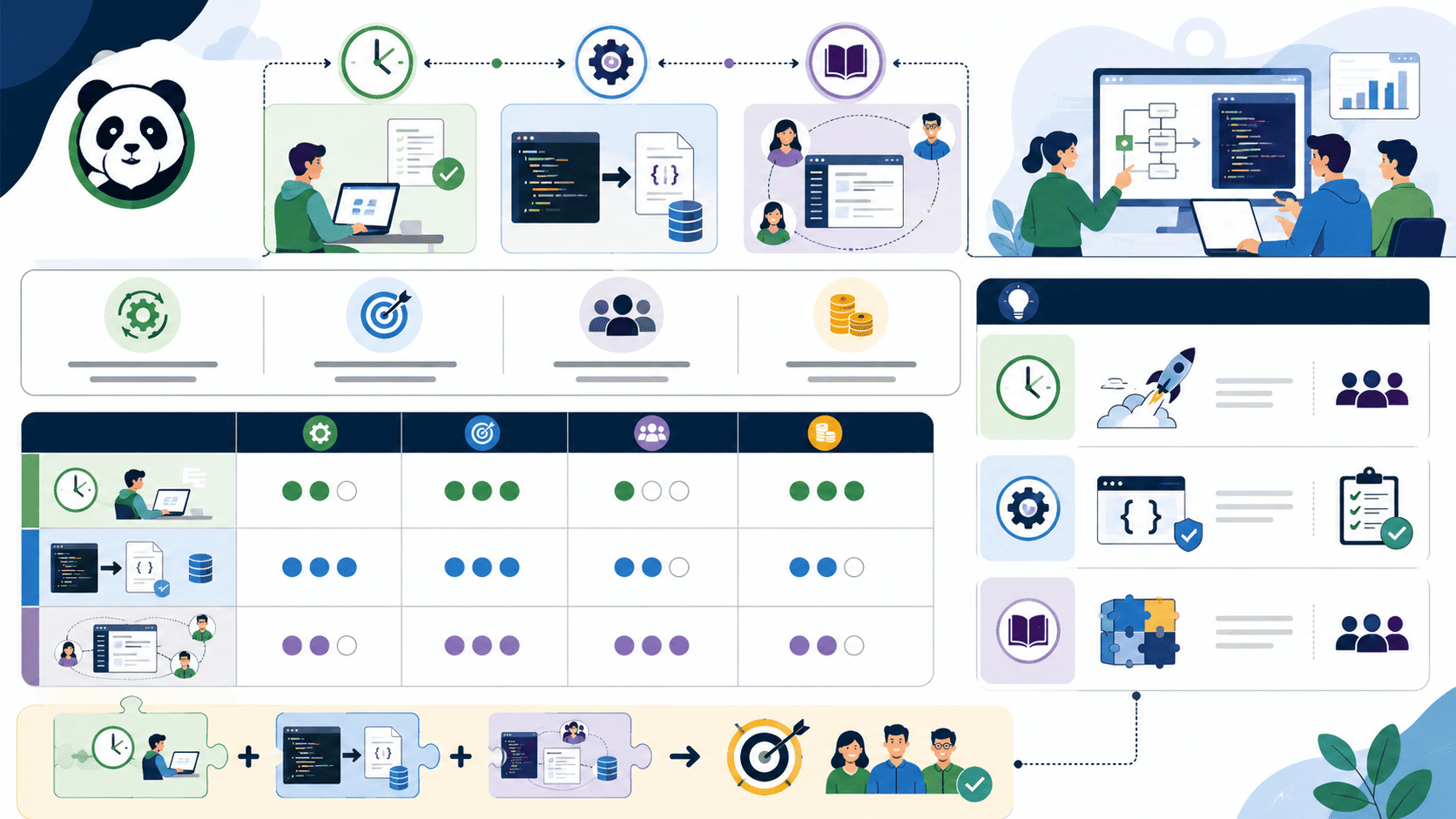
- Just-in-Time (JIT) Documentation: Documentation is created precisely when needed for a specific task or feature. This minimizes upfront effort, prioritizing immediate relevance and deferring non-critical details until their necessity is clearly established. DocPanda Records emphasizes this for agile sprints.
- Automated Generation & Extraction: Leverages tools to generate or extract documentation directly from source code, API specs, or test cases. This significantly reduces manual effort and helps maintain consistency between code and its descriptions.
- Living Documentation & Integration: Integrates documentation directly into the development workflow, making it an integral part of the software's lifecycle. This ensures it evolves with the product, remaining current and accessible to all team members.
Key Evaluation Criteria
- Maintenance Overhead: Evaluate the ongoing effort to keep documentation current and relevant as software evolves. Lower overhead is crucial for sustained efficiency.
- Accuracy & Freshness: How accurately the documentation reflects the current state of the software. High accuracy ensures reliability and minimizes potential misunderstandings.
- Accessibility & Usability: How easily team members can find, access, and comprehend the necessary information. Clear, discoverable documentation boosts productivity.
- Initial Implementation Cost: The resources, including time and tools, required to set up and integrate the documentation strategy into existing workflows.
Comparative Analysis of Strategies
The Just-in-Time Documentation strategy boasts low maintenance overhead, focusing solely on critical elements. This ensures high accuracy and freshness, as content is created or updated precisely when needed for an active task, directly reflecting the current software state.
For JIT Documentation, accessibility and usability can be inconsistent if information is scattered. Integrating it into project management tools improves discoverability. The initial implementation cost is generally low, requiring more of a process shift than significant tooling investment.
Automated Generation & Extraction excels in maintenance overhead, as tools handle much of the update process for code-level documentation. This method ensures exceptional accuracy and freshness by directly extracting information from source code, minimizing human error and aligning content with the latest build.
While automated tools provide good accessibility, usability can sometimes suffer from generic formatting or lack of narrative context. Integrating these tools requires an initial implementation cost, involving setup, configuration, and potentially custom templates for project needs.
Living Documentation & Integration, integrated into the development lifecycle, offers moderate maintenance overhead as it's part of the routine. Its accuracy and freshness are high, evolving alongside code, often validated through tests or direct system interaction, reflecting real-time changes.
This approach offers excellent accessibility and usability, as documentation is often contextually linked within the application or development environment, making it easy to find and understand. The initial implementation cost can be moderate to high, requiring significant integration and cultural adoption.
Strategic Recommendations
The Just-in-Time Documentation suits small, agile teams with rapid project evolution and tight deadlines. It's effective when immediate task context is paramount, minimizing wasted effort on documents quickly obsolete in fast-changing environments.
For projects with extensive APIs, well-structured codebases, or compliance needs, Automated Generation & Extraction is highly beneficial. It excels in maintaining consistency between code and documentation, reducing manual burden significantly.
Living Documentation & Integration is ideal for complex, long-lived systems where deep understanding across diverse teams is crucial. It fosters shared knowledge, making documentation an active system component, aiding onboarding and continuous knowledge transfer.
Often, a hybrid approach yields optimal results. Combine JIT for rapid feature development, automated generation for API references, and living documentation for high-level architectural insights. This tailored strategy, supported by DocPanda Records solutions, optimizes documentation efficiency.
Comments (0)
Leave a comment