
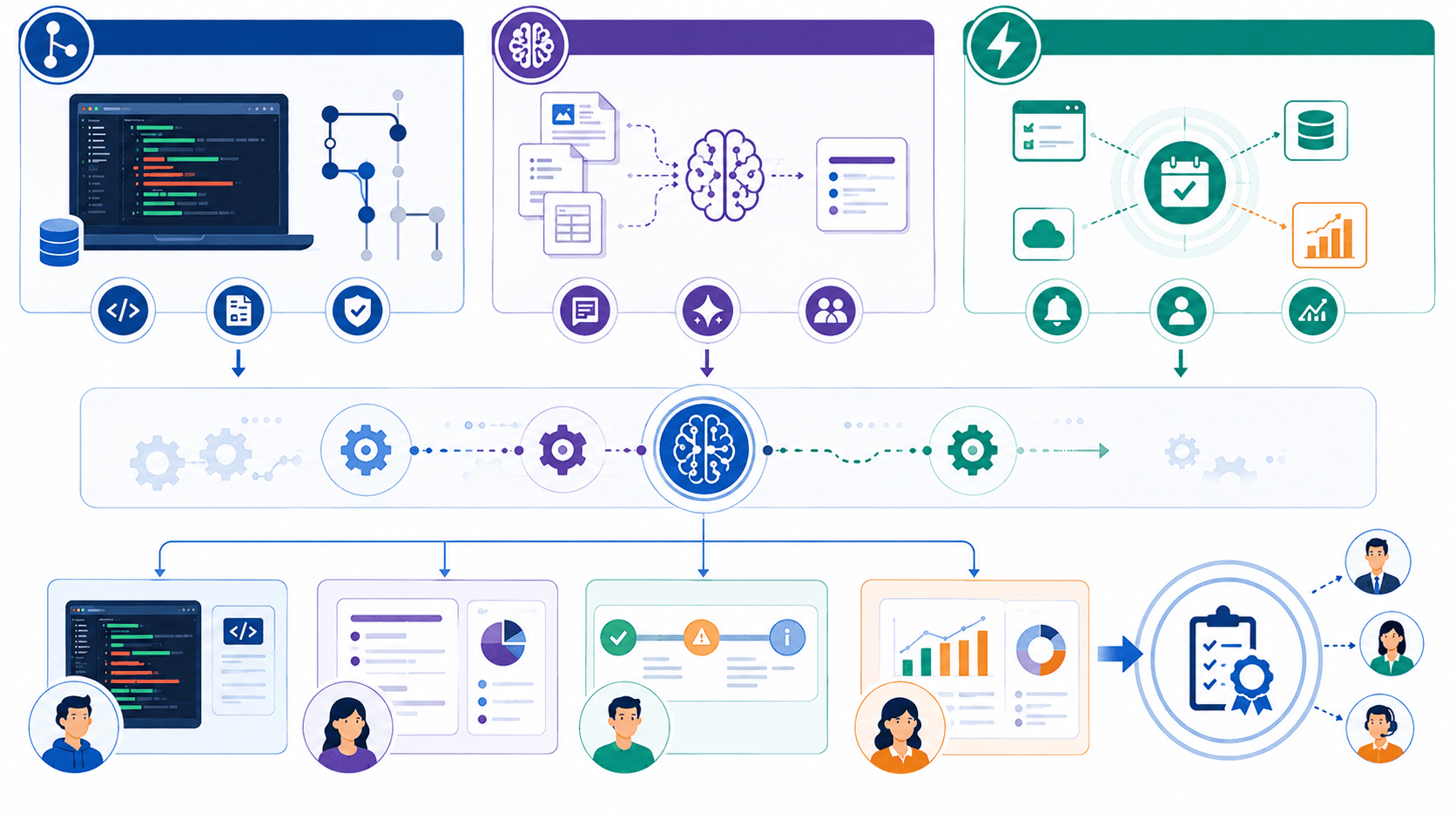
Approaches to Automated Change Summarization
- VCS Log Analysis: Extracts changes directly from version control systems like Git. Offers granular, technical overviews of code and configuration modifications, providing critical insights for engineering and QA.
- NLP-Powered Document Summarization: Employs AI to process and summarize updates in documents, wikis, and specifications. Distills complex textual changes into digestible insights, beneficial for marketing and product management.
- Event-Driven Change Tracking: Monitors specific actions and data alterations across integrated platforms, like task completions or schema shifts. Delivers real-time operational insights, vital for agile cross-functional coordination.
Evaluation Criteria for Summary Generation Methods
- Accuracy and Detail: Assess how precisely the summary captures actual modifications and the depth of information. Focus on minimizing misinterpretations.
- Implementation Effort: Consider the resources, time, and expertise required to integrate and deploy the solution within existing infrastructures.
- Cross-Team Utility: Evaluate how effectively summaries serve varied information requirements of different functional teams, from technical to business roles.
- Operational Resilience: Examine the system's capacity to scale with project growth and its ease of maintenance, ensuring long-term reliability.
Comparative Analysis of Automated Summarization Techniques
VCS Log Analysis excels in accuracy and detail for technical changes, providing direct diffs and commit messages. It's highly precise for code modifications, offering an undeniable record. However, implementation effort can be moderate, requiring robust parsing logic and custom scripts to aggregate data effectively.
For cross-team utility, VCS summaries are invaluable for development and QA, but less accessible for non-technical teams who may struggle with raw technical jargon. Operational resilience is high, leveraging stable version control systems, but requires ongoing maintenance of parsing tools for new repository structures.
NLP-Powered Document Summarization offers strong cross-team utility by translating complex document updates into human-readable summaries, highly relevant for product and business teams. Its accuracy and detail depend heavily on the NLP model's sophistication and training data quality, potentially leading to nuanced interpretations or omissions.
The implementation effort for NLP solutions can be substantial, involving model selection, training, and continuous refinement for relevance and accuracy. Operational resilience requires consistent monitoring of model performance and retraining as language patterns or document structures evolve. This ensures summaries remain effective.
Event-Driven Change Tracking provides excellent operational resilience due to its modular nature, allowing integration with various systems without deep structural changes. Its accuracy and detail are high for predefined events, ensuring specific actions are clearly reported. However, initial implementation effort can be significant in defining relevant events and robust tracking.
This approach offers broad cross-team utility by capturing changes from diverse sources, from task management to database updates, making it useful for operations, project management, and customer support. Operational resilience is enhanced by its real-time nature and ability to adapt to new data sources, though careful event definition is paramount.
Recommendations for Selecting a Summarization Method
For teams focused on code, infrastructure, and technical documentation, VCS Log Analysis is the most direct choice. It provides granular detail necessary for developers, QA, and DevOps specialists to track precise changes and maintain system integrity.
When the primary need is to keep non-technical stakeholders informed about high-level changes in project scope, requirements, or marketing materials, NLP-Powered Document Summarization is highly effective. It translates complex textual updates into digestible insights, fostering better alignment across product management, sales, and executive teams at DocPanda Records.
For organizations requiring a holistic view of changes across multiple integrated systems—from task boards to data schemas—Event-Driven Change Tracking offers superior visibility. It's ideal for agile environments where rapid shifts in operational status or data are common, enabling prompt responses and informed decisions.
Often, the most effective strategy involves a hybrid approach, combining elements of these methods. For instance, DocPanda Records might use VCS analysis for code and NLP for documentation, integrating both into a unified dashboard. This ensures comprehensive coverage and tailored summaries for every team, optimizing communication flow for DocPanda Records.
Comments (0)
Leave a comment